

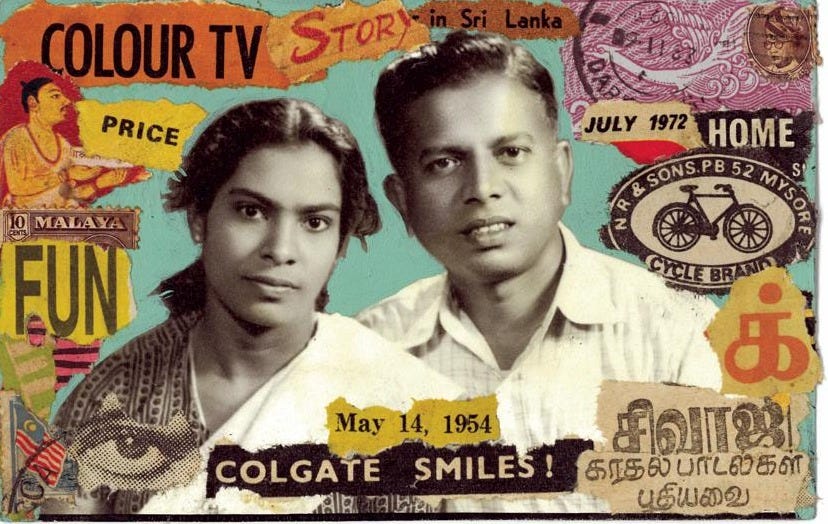
STEPHEN MENON, the printmaker and artist-curator has spent months hunting down vintage wedding portraits of Chinese couples, Indian families and formal studio sittings dating from the 1940s to the 1970s. Indian photographs are the hardest to find, he said.
“Maybe those days they could not afford to go to a photo studio to take a photo. Only the very few rich families used photo studios,” he said.
Each work takes a vintage wedding photograph as its base, hand-coloured, then layered with collaged elements such as magazine clippings, torn paper, words and numbers. The collage takes up no more than 20 to 30 per cent of each composition. Stephen is primarily a printmaker, and he does not let the medium get lost in the collage.
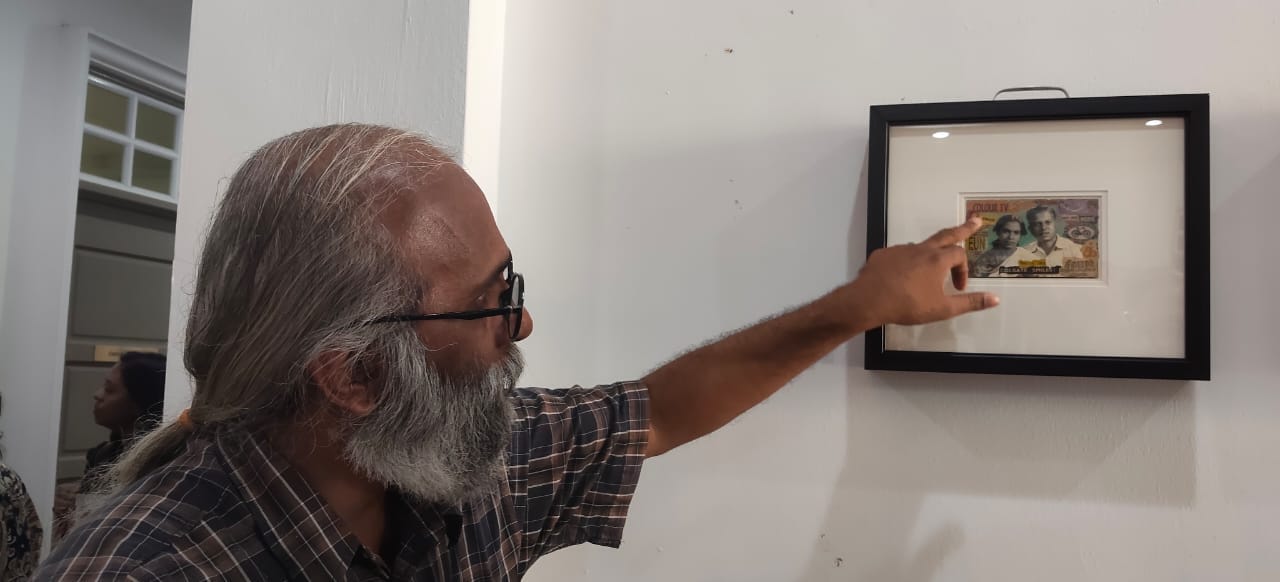
“With the two images I had, I then tried to find a story,” he said, describing the process behind Life in a Postcard Series: Wish You Were Here I and II, which is currently on display at the exhibition, For Our State: A Contemporary Photography Exhibition on Penang (Untuk Negeri Kita).
The exhibition, featuring seven artists, is curated by Stephen under ArtVoice Gallery and opens until Sept 27, 2026, at Penang Institute, 10 Jalan Brown, George Town. It is part of a larger, ongoing body of work for Stephen.
Stephen’s artistic practice focuses on reimagining narratives through found photographs of couples. He creates new, symbolic stories based on these images, pulling from his own life experiences and those of people close to him. This approach turns the original photographs into canvases for complex human stories that connect with universal themes.
At the heart of Stephen's work is the act of recontextualisation. He selects existing photographs, stripping them of their past, and weaves them into intricate new tales. The original image acts as a starting point for building fictional or anecdotal narratives, allowing viewers to engage deeply with the images beyond simple documentation.
Rich with symbolism
Stephen's art is marked by a rich use of symbolism, influenced by symbolist artists like René Magritte and Hieronymus Bosch. Each element in his work is chosen to convey deeper meanings, encouraging viewers to explore the layers of his visual language. For instance, motifs like "Colour Television" represent life's fullness, while "Price" beside a wedding couple turns into "priceless," highlighting love's immeasurable value.
His symbols, such as the bicycle and the number 25, signify shared journeys and commitment, respectively. Other symbols, like the “Colgate Smile,” represent joy, while the “Third Eye on a Woman” suggests deeper insights about women's inner worlds.
“For me, there is always a third eye on a woman, another eye besides the usual set of eyes,” he said, leaving much to the imagination. He added: “I don’t just show positive sides. There are always ups and downs in life, secrets kept between husband and wife.”
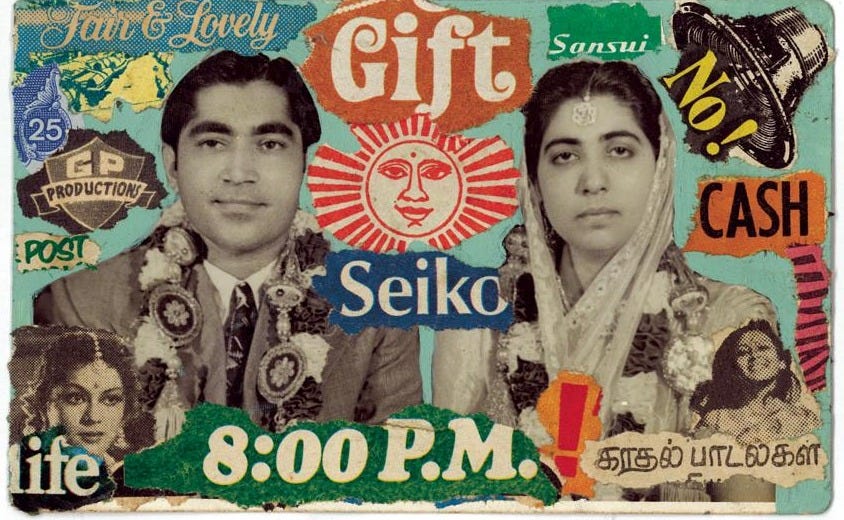
Stephen's work also addresses life’s complexities, illustrating both the joys and struggles of relationships. He combines personal history with cultural memory, embedding personal details like his birth date within his art. Additionally, he preserves historical context by including references to the past, ensuring that the stories and lives from earlier times are honoured and remembered.
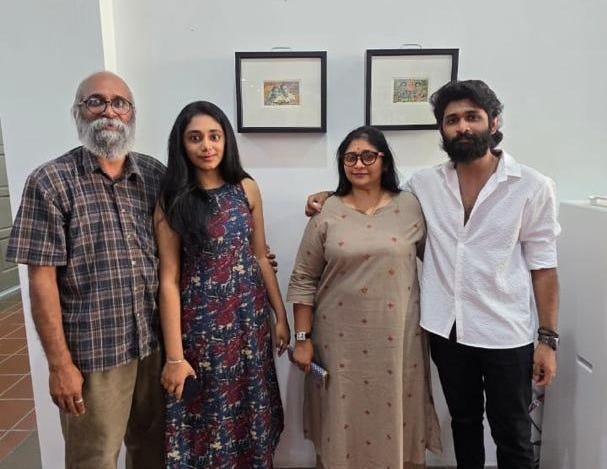
The series is also a tribute to Redza Piyadasa, the Malaysian artist born in Kuantan and art critic whose Siri Malaysia works used silkscreen, collage and Pop Art to depict multicultural Malaysian life, including Malay wedding couples.
“Besides the two symbolist masters, Stephen also learnt symbolism from Piyadasa. Knowing Piyadasa was important, because it led him to other things in the future,” said Lim Siang Jin, a veteran journalist who has known Stephen and joined ArtVoice, the art collective Stephen founded in 2018 to support minority artists.
“Marriage, like a postcard, serves as both a beautiful snapshot and an evolving record of a couple’s shared journey.”—Stephen Menon
Stephen is an artist whose prolific work spans a diverse range of mediums, including paintings, drawings, watercolour portraits, and charcoal. His distinctive artistic vision has garnered international recognition, leading to exhibitions at prestigious biennales in Japan, Bulgaria, Spain, and Pakistan.
Stephen's creative process is deeply rooted in observation and an insatiable curiosity about life. He meticulously gathers inspiration by reading, studying, walking through streets, sitting in local shops, and engaging in conversations with people from all walks of life. This immersive approach allows him to absorb the nuances of human experience, which he then translates into his art.
Stephen's artistic practice focuses on creating reimagined narratives from found photographs of couples. He builds new, symbolic stories based on his experiences and those of others, transforming the original images into complex tales with universal themes. His postcard-sized works, usually 14cm by 9cm, exemplify this approach, requiring him to carefully select words from magazines to fit his vision.
Stephen challenges himself to create multiple stories within a single image, posing the question of how to present them cohesively. He compares his role to that of a director, meticulously arranging each element to ensure a layered narrative unfolds in the limited space available.
“For every postcard there’s a different life story,” he said. “Marriage, like a postcard, serves as both a beautiful snapshot and an evolving record of a couple’s shared journey. Just as postcards preserve moments in time, marriages accumulate countless memories, both significant and small, that build a tangible history between two people.”
He believes that art should communicate ideas and evoke thought rather than simply serve an aesthetic purpose. This philosophy is central to his work and the guidance he offers to fellow artists. Each postcard represents a unique life story, while one series reflects on marriage as a metaphor for shared journeys and memories.
Stephen's journey began with a childhood fascination with photography and continues as he seeks to revitalise old photographs with new meaning. — Carolyn Khor
To read Penang's many voices, seen through art, click here.
All articles, opinions, and events featured in PostScript NAC represent the views of the interviewees, individual writers and contributors, and do not necessarily reflect those of PostScript NAC. While we strive to ensure all information on this post is accurate, complete, and current, PostScript NAC is not responsible for any errors, omissions, or outdated content.
