
Reimagining a nation
Lessons from a new anthology of Singapore after six decades of growth

Title: (Re)Defining Singapore
Editors: Fiona Leung, Bianca Cheo and Woon Tai Ho
Publisher: World Scientific Publishing
ISBN: 9789819824717
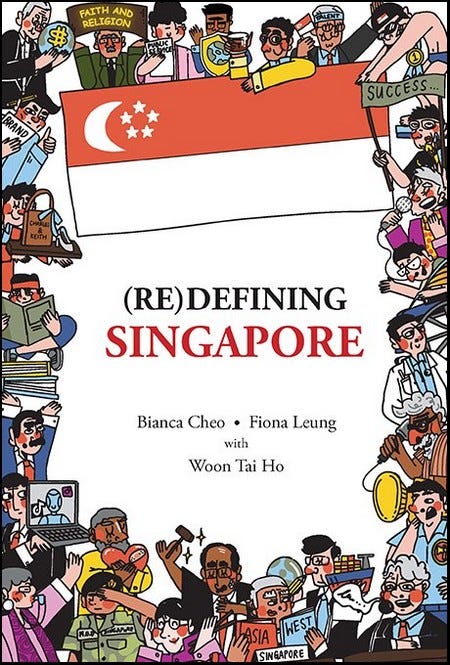
HOW does a small, intensely managed city-state—one that has astonished observers with its rapid rise from post-colonial fragility to global relevance—renew its story at 60? (Re)Defining Singapore answers this question not through a single narrative but through a chorus of 26 voices, each offering a different story about what Singapore has been and what it must become. The result is an expansive, thoughtful and highly readable anthology that captures a nation in mid-reflection.
The book is organised into five parts, each tackling a facet of the Singaporean condition. The first section, “Shaping Singapore’s Place in the World”, lays the foundation with contributions from some of the country’s most respected thinkers and diplomats.
Among them, Prof Tommy Koh Thong Bee offers a compelling overview of Singapore at 60, anchoring the nation’s present by revisiting its past. Koh recalls life under British and Japanese rule, the turbulent early years of self-government, and the rise of the People’s Action Party under Lee Kuan Yew. His reflections are poignant reminders of how unlikely Singapore’s success once seemed. The transformation from Third World to First, he notes, defied the expectations of many external observers. Yet Koh is not content to celebrate past achievements; he poses a sober question that frames the rest of the book: Will the miracle continue?
Equally insightful is Prof Chan Heng Chee’s essay on the evolution of Singapore’s political leadership, tracing the arc from Lee Kuan Yew to the present prime minister, Lawrence Wong. Her reflections highlight both continuity and adaptation within the political system, offering readers a sharp but accessible primer on how leadership style, public expectations and geopolitical realities have shifted across generations.
Rounding off the diplomatic perspectives, Kishore Mahbubani provides a characteristically nuanced piece on Singapore’s role in the Asian century. Framed against the backdrop of an intensifying China-US rivalry, Mahbubani argues that survival for a small state hinges on strategic agility, clarity of interests and the willingness to redefine diplomatic posture. His essay situates Singapore not as a passive actor navigating great-power tensions, but as a nimble player capable of shaping outcomes through foresight and deft statecraft.
#### Read here our story, Night of reflection, renewal and shared purpose, on the launch event of the anthology at the National Gallery Singapore on November 17, 2025
Beyond the corridors of diplomacy and statecraft, the anthology’s strength lies in its inclusion of voices from the margins, civil society, and everyday life. Mohammed Saleem, co-founder of the social enterprise LifeCraft, contributes one of the book’s most affecting chapters, “From the Margins to the Middle”. In candid prose, he recounts his own past struggles with drug addiction, the turning point offered by a mentor who restored his dignity, and his decision—together with Jerome Emmanuel—to create LifeCraft to support at-risk youth and individuals rebuilding their lives. As a maturing society, he says Singapore has mastered the hardware; now it must master the “heartware”. His story adds a humanising dimension to the anthology, reminding readers that nation-building is not only institutional, but profoundly personal.
The political spectrum is further broadened by an essay by Michael Thng, a Workers’ Party member, who shares his internal dilemmas and his eventual decision to step forward as a candidate. His narrative is quietly powerful, offering insight into civic courage, party identity and the emotional weight of political participation in a tightly contested but maturing democracy.
Similarly, PN Balji, a veteran journalist with four decades of experience, offers an incisive piece on how and what the opposition, especially the Workers’ Party, needs to do to become not just a credible opposition in Parliament but eventually the alternative government.
The book also celebrates the realm of sport and ambition through Joseph Schooling, Singapore’s first Olympic gold medallist. In his contribution, “Dare to Dream”, Schooling recounts the pressures, sacrifices and relentless drive behind his historic victory at the 2016 Rio Games. His story, while familiar to many Singaporeans, gains renewed resonance.
In exploring the generational “bridge,” the book compellingly outlines what must change but is sometimes less forthcoming about how change might realistically unfold.
Despite this constraint, (Re)Defining Singapore succeeds in capturing a nation at a reflective milestone. At 60, Singapore stands between its founding mythology and its uncertain, opportunity-filled next act. The editors frame the central challenge memorably: What must change for Singapore to stay relevant and remain special?
For readers interested in culture, policy, identity and the evolution of nationhood, this anthology offers a thoughtful and engaging entry point. It does not attempt to be a final word — nor should it. Instead, it sparks the very discourse it argues is essential: that nation-building is not a completed project, but a continuing, evolving and shared responsibility. – Sebastian Lim
Review copy courtesy of (Re)Defining SG. The hardcopy edition retails at SGD65 while the paperback edition is at SGD36.
All articles, opinions, and events featured in PostScript NAC represent the views of the interviewees, individual writers and contributors, and do not necessarily reflect those of PostScript NAC. While we strive to ensure all information on this post is accurate, complete, and current, PostScript NAC is not responsible for any errors, omissions, or outdated content.
(